

Historical Origins and Theology of the Miraculous Medal
MMN|
Editorial Team
In the quiet hours of July 18-19, 1830, a young novice named Catherine Labouré experienced something that would transform Catholic devotion for centuries to come. In the chapel of the Daughters of Charity on Rue du Bac in Paris, the Blessed Virgin Mary appeared to her, revealing a medal design that would become one of the most widely distributed religious objects in history. This article explores the historical context of these apparitions and unpacks the rich theological symbolism woven into every element of the Miraculous Medal’s design.
The Historical Context of 1830 Paris
To understand the significance of the Miraculous Medal, we must first understand the world into which it emerged. Post-revolutionary France was a society in spiritual crisis. The French Revolution (1789-1799) had violently suppressed religious institutions, confiscated church property, and attempted to replace Christianity with secular rationalism. By 1830, while religious freedom had been restored, the faith remained weakened, and many Catholics struggled to reconnect with their spiritual heritage. It was into this environment of religious uncertainty that nineteen-year-old Catherine Labouré entered the convent of the Daughters of Charity. Born in 1806 in rural Burgundy, Catherine had experienced mystical visions since childhood, including a prophecy that she would care for the sick and eventually receive a mission from the Blessed Virgin. Her entrance into religious life positioned her at the center of what would become a pivotal moment in Marian devotion.
The Apparitions: A Detailed Account
The apparitions occurred in three distinct phases, each revealing deeper dimensions of the medal’s meaning and purpose. On the night of July 18, Catherine reported being awakened by a child dressed in white who led her to the chapel. There, she encountered a beautiful lady seated in the sanctuary, who identified herself only indirectly but conveyed a message of divine commission. This initial encounter established Catherine as a chosen instrument and prepared her for the revelations to come. The lady told Catherine: “God wishes to charge you with a mission. You will be contradicted, but do not fear; you will have grace to do what is necessary.”
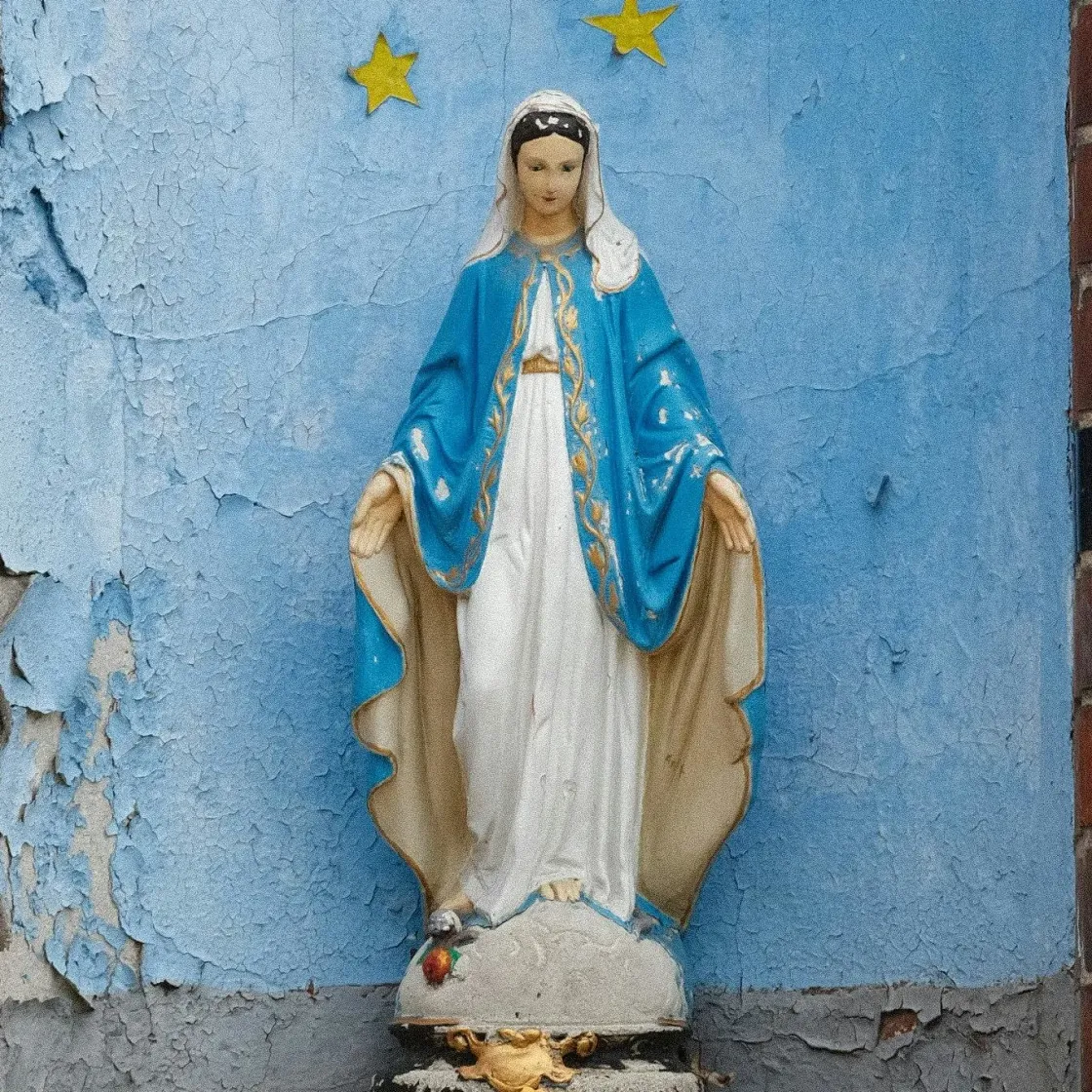
The crucial revelation occurred on November 27, when the Blessed Virgin appeared standing on a globe, holding another globe in her hands. She wore a white robe and mantle, and on her fingers were rings set with precious stones that emitted rays of light toward the earth. Around her head appeared the words: “O Mary, conceived without sin, pray for us who have recourse to thee.” As Catherine watched, the image rotated to reveal the reverse side: the letter M surmounted by a cross, with the Sacred Hearts of Jesus and Mary beneath. The Virgin instructed: “Have a medal struck after this model. All who wear it will receive great graces, especially if they wear it around the neck. Graces will be abundant on those who wear it with confidence.”
In December, the Virgin returned to confirm the mission and address Catherine’s concerns about distributing the medal. She reassured the young nun that the work would spread throughout the world, despite initial resistance and skepticism from ecclesiastical authorities.
Theological Symbolism: Decoding the Design
Every element of the Miraculous Medal carries profound theological meaning, creating a visual catechism that communicates core Catholic doctrines. The image of Mary standing on a globe represents her universal motherhood and queenship over all creation. This imagery draws from traditional Catholic theology that honors Mary as Queen of Heaven and Earth, a title rooted in her unique role as Mother of God (Theotokos). The globe beneath her feet symbolizes her dominion extends to all peoples, nations, and cultures—a particularly powerful message in post-revolutionary Europe where nationalism was rising and the Church’s universal authority was being challenged.
The rays emanating from Mary’s jeweled hands represent the graces she mediates to humanity. Notably, some stones do not emit rays—these represent graces that people forget to ask for or fail to receive due to lack of faith or prayer. This detail teaches important theological truths: that grace is abundant and freely offered, but human cooperation through prayer and faith is necessary to receive it fully. It also emphasizes Mary’s role as Mediatrix of All Graces, a doctrine that understands Mary not as the source of grace (which is God alone) but as the channel through which God’s graces flow to humanity.
Perhaps the most theologically significant element of the medal is the inscription: “O Mary, Conceived Without Sin.” In 1830, the dogma of the Immaculate Conception had not yet been formally defined by the Church (that would occur in 1854, twenty-four years later). Yet here, decades before official proclamation, the medal proclaims Mary’s conception without original sin. This represents a remarkable instance of private revelation anticipating and supporting doctrinal development. The invocation “pray for us who have recourse to thee” establishes the medal as a tool of intercessory prayer, affirming the Catholic understanding of the communion of saints and Mary’s ongoing maternal care for the faithful.
The reverse side features the letter M (for Mary) surmounted by a cross, symbolizing Mary’s intimate participation in Christ’s redemptive work. The cross rising from the M represents Calvary, where Mary stood at the foot of the cross, sharing in her Son’s suffering. This imagery connects to the ancient title “Co-Redemptrix” (not in the sense of equal redemption, which belongs to Christ alone, but as participating uniquely in the work of salvation through her fiat and her suffering). Beneath the M appear two hearts: the Sacred Heart of Jesus, crowned with thorns, and the Immaculate Heart of Mary, pierced by a sword. These symbols reference specific biblical passages and devotional traditions—Jesus’ Sacred Heart represents divine love, sacrifice, and the wounds of the Passion, recalling Christ’s suffering and his infinite love for humanity, while Mary’s Immaculate Heart references Simeon’s prophecy in Luke 2:35: “And a sword will pierce your own soul too,” signifying Mary’s sorrows, particularly her witnessing of Christ’s crucifixion, and her pure, sinless heart completely united to God’s will. Together, these hearts demonstrate the perfect union between Christ’s redemptive love and Mary’s cooperative love, showing how human response to divine grace reaches its perfection in the Blessed Virgin.
The Medal’s Early Reception and Spread
Despite the Virgin’s promise that the medal would spread throughout the world, initial reception was cautious. Archbishop de Quélen of Paris authorized the medal’s production in 1832, but distribution began slowly. The first medals were struck in June 1832, and within the first year, several thousand were distributed in Paris alone. What followed exceeded all expectations. Reports of conversions, healings, and other graces associated with wearing the medal multiplied rapidly. The cholera epidemic of 1832 provided a dramatic context for the medal’s spread, as many who wore it reported protection or healing. Within a decade, millions of medals had been distributed across Europe and beyond.
Notable early conversions attributed to the medal include Alphonse Ratisbonne, a Jewish banker who experienced a dramatic conversion in 1842 after wearing the medal and praying the invocation. His conversion became one of the most famous testimonies associated with the medal and helped establish its reputation as an instrument of grace.
Theological Implications for Contemporary Faith
The Miraculous Medal’s enduring significance extends far beyond its historical origins. Several theological themes remain profoundly relevant for contemporary believers. In an increasingly globalized and pluralistic world, the medal’s affirmation of Mary’s maternal care for all peoples offers a vision of unity transcending cultural, national, and religious boundaries. Her outstretched hands emitting rays of grace suggest that divine love knows no borders.
The detail of the stones that don’t emit rays reminds modern believers that grace, while freely offered, requires our active reception through prayer, faith, and openness. This counters both passive fatalism and Pelagian self-reliance, presenting a balanced theology of divine-human cooperation. The medal’s imagery affirms Mary’s unique position in salvation history—not as equal to Christ, but as his perfect disciple and our spiritual mother. This understanding enriches Catholic Mariology while maintaining proper Christocentric focus.
The Miraculous Medal exemplifies the Catholic understanding of sacramentals—sacred signs that prepare us to receive grace and dispose us to cooperate with it. Unlike sacraments, which confer grace ex opere operato (by the very fact of the action being performed), sacramentals work through the Church’s prayer and the faith of the user. The medal thus encourages active, conscious participation in one’s spiritual life rather than superstitious reliance on objects.
Conclusion: A Living Tradition
Nearly two centuries after its origin, the Miraculous Medal continues to speak to the human heart’s deepest longings for divine connection, maternal care, and spiritual protection. Its historical roots in 1830s Paris connect us to a specific moment of revelation, while its theological richness ensures its relevance across cultures and generations. For contemporary Catholics, the medal offers more than a devotional object—it provides a visual theology, a reminder of Mary’s maternal presence, and an invitation to deeper faith. As we wear or venerate the Miraculous Medal, we participate in a living tradition that spans nearly two hundred years, connecting us to countless believers who have found grace, comfort, and conversion through this simple yet profound sacramental.
The medal’s continued popularity—hundreds of millions distributed worldwide—testifies not to superstition or mere habit, but to the enduring power of its message: that Mary, conceived without sin, continues to pray for us and mediate graces to all who have recourse to her.
Explore more research on Marian devotion and the Miraculous Medal tradition in our Research Collection.