

Blue Symbolism in Marian Art
MMN|
Editorial Team
Among all colors in religious art, none is more intimately associated with the Blessed Virgin Mary than blue. From the Miraculous Medal’s azure mantle to Renaissance Madonnas’ ultramarine robes, from Guadalupe’s star-studded turquoise cloak to Lourdes’ delicate sash, blue appears as Mary’s signature color across centuries and cultures. But why blue? What theological, historical, and symbolic meanings does this color carry? This article explores the fascinating story of “Marian blue,” tracing its evolution from expensive pigment to universal symbol, and examining what this color reveals about Catholic understanding of Mary’s role in salvation history.
Historical Origins: The Economics of Ultramarine
To understand blue’s association with Mary, we must begin not with theology but with economics. In medieval and Renaissance Europe, the finest blue pigment was ultramarine, derived from lapis lazuli, a semi-precious stone mined primarily in Afghanistan and transported along dangerous trade routes to Europe. Ultramarine was extraordinarily expensive—often costing more than gold by weight. A single pound could cost several years’ wages for a skilled craftsman. This extreme cost meant that using ultramarine was significant financial investment, reserved for most important subjects in religious paintings.
When wealthy patrons commissioned religious artworks, they specified which figures should receive ultramarine. Naturally, Jesus and Mary—the central figures of Christian faith—received this honor. Over time, the practice became so standardized that blue became automatically associated with Mary, regardless of actual pigment cost. Beyond cost, ultramarine possessed superior qualities including unmatched intensity and luminosity, stability that didn’t fade or discolor over time (unlike cheaper blues), versatility allowing various shades while maintaining richness, and prestige demonstrating patron’s wealth and devotion. Thus, practical considerations (cost, quality, availability) established blue as Mary’s color long before theological reflection caught up with artistic practice.
Theological Development: From Practice to Symbol
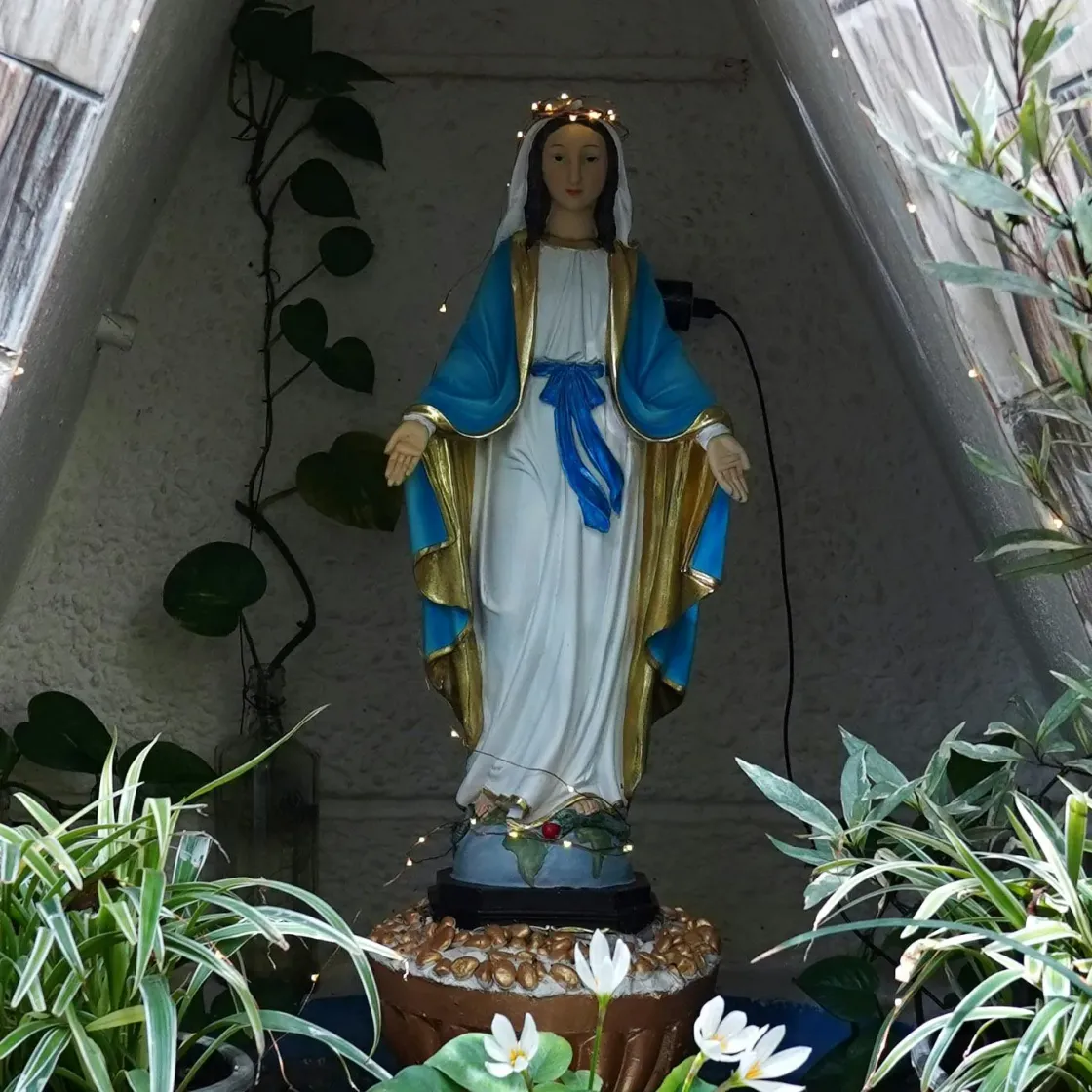
As blue became standard for depicting Mary, theologians and preachers began articulating reasons why this color was appropriate, transforming economic accident into theological intention. Blue’s most obvious symbolic connection is to sky and heaven. By clothing Mary in blue, artists visually affirmed her title as “Queen of Heaven” and her assumption body and soul into heavenly glory. The color reminds viewers that Mary, though human, now participates fully in divine life. For the Miraculous Medal specifically, Mary’s blue mantle signifies her heavenly origin and eternal destiny, while her white robe represents earthly purity. Together, these colors express the mystery of Incarnation—divine taking on human nature—played out in Mary’s own life.
In medieval color symbolism, blue represented truth, constancy, and fidelity. These virtues perfectly describe Mary’s character: she bore Truth Himself (Jesus Christ) in her womb, remained faithful through joy and sorrow from Bethlehem to Calvary, and her “yes” to God never wavered even when circumstances were difficult or dangerous. The Miraculous Medal’s inscription—“O Mary, conceived without sin”—proclaims ultimate truth about Mary’s identity, making blue particularly appropriate.
Paradoxically, blue also symbolized humility in medieval thought. This seems contradictory given blue’s expense, but the reasoning was profound: Mary, though Queen of Heaven, remained humble servant. Her greatness lay precisely in her humility—her willingness to be God’s instrument rather than asserting her own importance. This paradox resonates deeply with the Miraculous Medal message. Mary stands on globe (signifying queenship) yet extends hands in service (signifying humility). She is both exalted and accessible, royal and maternal, glorious and approachable. Blue captures this tension beautifully. Additionally, lighter shades of blue suggest purity, innocence, and virginity—all central to Catholic understanding of Mary. Her perpetual virginity, immaculate conception, and sinless life are visually expressed through blue’s clean, clear tones. On the Miraculous Medal, the combination of white (traditional purity color) and blue creates layered symbolism: white emphasizes Mary’s personal holiness; blue emphasizes her heavenly glory. Together, they present complete picture of sanctity.
Blue in the Miraculous Medal: Specific Significance
The Miraculous Medal’s use of blue carries particular theological weight beyond general Marian associations. The medal’s primary message concerns Mary’s Immaculate Conception—her preservation from original sin from moment of conception—and blue reinforces this doctrine in several ways. First, blue suggests state of innocence before Adam and Eve’s sin, connecting Mary to humanity’s original holiness. Second, since Mary was conceived without sin, she shares more directly in heavenly realities, and blue visually expresses this unique relationship to divine realm. Finally, just as God created world ex nihilo (from nothing), He created Mary free from sin’s stain, and blue, as sky/heaven color, suggests this new creative act.
Mary’s blue mantle on the Miraculous Medal envelops her entire figure, suggesting embrace. This visual metaphor communicates her universal motherhood—all people are covered by her maternal care, just as sky covers earth. The rays emanating from her hands pass through this blue mantle, suggesting that graces flow from heaven (blue) through Mary to earth (globe under feet). The color thus becomes integral to medal’s theology of mediation.
The medal’s two-tone scheme (white robe, blue mantle) creates important theological distinction: the white robe represents Mary’s personal holiness, purity, and resurrection life, while the blue mantle signifies her heavenly glory, queenship, and role as grace mediator. Together, these colors present balanced Mariology—neither reducing Mary to merely human status nor elevating her to divine level, but honoring her unique position as highest of creatures and mother of God.
Cultural Variations: Blue Across Contexts
While blue remains consistently associated with Mary, its specific shade and application vary across cultures, reflecting local aesthetic preferences and theological emphases. European traditions show remarkable diversity: Italian Renaissance favored deep ultramarine, rich and saturated, emphasizing royalty and divinity; French Baroque employed medium blue with dramatic lighting effects, highlighting emotional intensity; Spanish Colonial used vibrant cobalt blues, reflecting Mediterranean light and passion; and German Gothic preferred cooler, more somber blues, emphasizing contemplation and mysticism. The Miraculous Medal, originating in France, typically shows medium to dark blue, consistent with French artistic traditions of 19th century.
Latin American adaptations demonstrate inculturation at its finest. Our Lady of Guadalupe features a blue-green (turquoise) mantle with gold stars, incorporating indigenous color preferences and astronomical symbolism. Our Lady of Aparecida in Brazil displays a dark blue mantle, reflecting both European tradition and local textile dyes. Andean regions blend bright blues with traditional Andean textile patterns. These adaptations demonstrate inculturation—faith expressing itself through local artistic languages while maintaining essential theological content.
Asian interpretations bring their own distinctive aesthetics. Chinese porcelain blue influences Marian images through blue-and-white ceramics, creating distinctive aesthetic. Japanese indigo dye produces softer, more muted blues. Indian miniatures feature vibrant blues influenced by Mughal painting traditions, while Filipino devotion showcases bright, cheerful blues reflecting tropical sensibilities. African expressions include bold blue patterns incorporated into West African textile designs, deep rich blues in Ethiopian iconographic traditions, and diverse blue applications in contemporary African art reflecting continental diversity. These variations prove that while blue is universal Marian color, its expression can be culturally specific, allowing local communities to make Mary truly their own.
Scientific and Psychological Dimensions
Modern science offers additional insights into why blue resonates so powerfully in Marian devotion. Research in color psychology suggests blue produces specific psychological responses: it lowers heart rate and blood pressure, promoting tranquility; inspires confidence and reliability; encourages contemplation and transcendence; and paradoxically can evoke melancholy (hence “the blues”). These effects align remarkably well with Marian devotion. Mary brings peace to troubled hearts, inspires trust in God’s providence, encourages contemplative prayer, and shares in our sorrows (her heart was “pierced by sword”). Blue’s psychological impact supports these devotional dimensions.
Blue light has shortest wavelength in visible spectrum, scattering more than other colors (explaining why sky appears blue). This physical property means blue objects appear to recede visually, creating sense of depth and distance. When Mary wears blue, she seems simultaneously present and transcendent, near and far—a perfect visual expression of her role as bridge between heaven and earth. Studies show blue activates brain regions associated with spiritual experience, emotional regulation, memory formation, and aesthetic appreciation. This neurological basis may partly explain why blue Marian images prove so memorable and emotionally powerful across cultures and centuries.
Contemporary Challenges and Opportunities
In modern context, Marian blue faces both challenges and opportunities. Challenges include color proliferation through modern dye technology enabling unlimited choices, potentially diluting blue’s special status; secularization causing blue to lose its specifically Marian associations as society becomes less religious; gender stereotypes where blue’s traditional association with masculinity in modern Western culture creates potential confusion (though historically opposite was true); and commercial exploitation where mass production sometimes uses cheap, inaccurate blue shades that diminish aesthetic and theological quality.
However, opportunities abound. Blue’s association with sky and water connects to environmental concerns, allowing Marian devotion to engage creation care themes. Screens display blue brilliantly, enabling new forms of Marian art and devotion through digital platforms. International travel and communication expose people to diverse blue traditions, enriching understanding beyond local conventions. Contemporary artists experiment with blue in exciting ways, creating fresh interpretations that speak to modern sensibilities while honoring tradition.
Practical Guidance for Devotees and Collectors
For those seeking authentic Marian devotional items featuring appropriate blue, consider several quality indicators. Quality blue should be vibrant with rich saturation, not washed-out or muddy. The color should be uniform without unintended variations (unless intentional artistic effect). The shade should match the apparition being depicted (darker for Miraculous Medal, lighter for Lourdes, turquoise for Guadalupe), and the color shouldn’t fade, chip, or rub off with normal handling.
Avoid cheap imitations where very inexpensive items often use poor-quality dyes that fade quickly or appear artificial. Be wary of inaccurate colors where some manufacturers don’t research proper shades, producing theologically inappropriate colors. Resist over-embellishment where excessive decoration can distract from blue’s symbolic power, and practice cultural sensitivity when purchasing items from cultures different from your own.
Consider supporting authentic craftsmanship by purchasing from established religious goods suppliers with quality reputations, artisan cooperatives supporting traditional craftspeople, fair trade organizations ensuring ethical production, or local artists creating culturally appropriate expressions. Investing in quality honors both Mary and the artisans who create these sacred objects.
Conclusion: More Than Just a Color
The story of Marian blue reveals how material reality carries spiritual meaning. What began as economic necessity (expensive pigment reserved for important figures) became theological symbol (heaven, truth, humility, purity), then cultural tradition (recognizable marker of Marian identity), and finally spiritual resource (color that facilitates prayer and devotion). For the Miraculous Medal specifically, blue mantle is not decorative afterthought but essential theological statement. It proclaims Mary’s heavenly glory, her role as grace mediator, her universal motherhood, and her unique participation in salvation history. Every time we gaze upon the medal’s blue mantle, we’re reminded of these profound truths.
As we continue venerating Mary through images, statues, medals, and other devotional items, may we appreciate not just the beauty of blue but the depth of meaning it carries. May this color draw us deeper into mystery of Incarnation, inspire us to imitate Mary’s virtues, and remind us that heaven is closer than we think—just as close as the blue sky above our heads. In the end, Marian blue teaches us that matter matters—that physical things can mediate spiritual realities, that beauty leads to truth, and that God speaks through color just as surely as through words. Let us listen carefully to what blue says about Mary, and through her, about the God who loved her enough to conceive her without sin and assume her into heavenly glory.
Discover more about color symbolism and religious art in our Works Collection or explore authentic Marian devotional items in our Supply Guide.