Religious Metaphor in Marian Art
MMN|
Editorial Team
Religious art operates according to different principles than secular art. Where modern art often prioritizes individual expression, aesthetic innovation, or social commentary, religious art serves as visual theology—communicating doctrinal truths, facilitating prayer, and forming believers’ spiritual imagination. Marian apparition images, including the Miraculous Medal, employ rich symbolic language that rewards careful study. This article explores how religious metaphor functions in Marian art, helping viewers read these images with deeper understanding and appreciation.
The Nature of Religious Symbolism
Before examining specific Marian symbols, we must understand how religious symbolism differs from other symbolic systems. Catholic theology affirms that material reality can mediate spiritual truth. This “sacramental principle”—that visible signs convey invisible grace—underlies all seven sacraments and extends to religious art. Symbols in Marian images aren’t merely decorative or illustrative; they’re meant to participate in the realities they represent. When the Miraculous Medal shows rays emanating from Mary’s hands, this isn’t just artistic convention but visual affirmation that Mary truly mediates graces. The symbol participates in the reality, making present what it signifies.
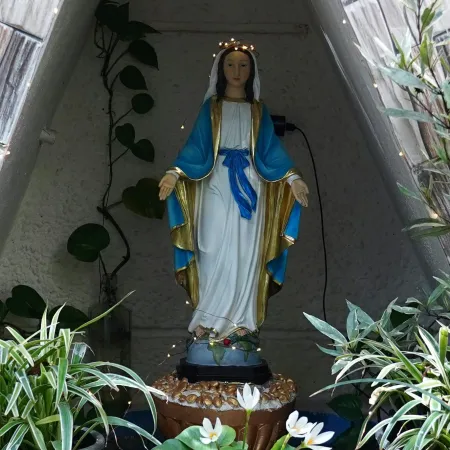
Religious symbols typically operate on multiple levels simultaneously. The literal level shows what is literally depicted (Mary standing, wearing blue). The allegorical level teaches doctrinally (Immaculate Conception, mediation of graces). The moral level indicates how viewers should respond (pray, trust, imitate Mary’s virtues). The anagogical level points to eternal realities (heaven, resurrection, divine glory). Understanding these layers enriches engagement with religious art, transforming passive viewing into active contemplation.
Religious symbols function as communal language—shared vocabulary enabling believers to communicate complex theological ideas efficiently. When Catholics see Mary standing on globe with rays from hands, they immediately recognize Miraculous Medal and its associated meanings. This shared visual language creates community identity and facilitates faith transmission across generations and cultures.
Core Symbols in the Miraculous Medal
Let’s examine key symbols in the Miraculous Medal and unpack their theological meanings. The globe beneath Mary’s feet represents sphere under her feet literally, while allegorically signifying Mary’s queenship over all creation, universal scope of her maternal care, dominion extending to all peoples nations and cultures, and fulfillment of Genesis 3:15 (woman crushing serpent’s head). Morally, it calls us to trust in Mary’s universal intercession, recognize that no one is beyond her maternal care, and pray for entire world not just personal concerns. Anagogically, it points to new creation restored through Christ, earth redeemed and subjected to heavenly queen, and eschatological hope for cosmic redemption.
The rays emanating from rings on Mary’s fingers literally show beams of light, while allegorically representing graces flowing from God through Mary to humanity, Mary as Mediatrix of All Graces, abundance of divine generosity, and some graces not received due to lack of prayer or faith (stones without rays). Morally, they encourage us to pray confidently asking for needed graces, cooperate with grace through faith and good works, remember to ask since many graces await our petition, and trust in Mary’s constant intercession. Anagogically, they suggest eternal flow of divine love, heaven’s inexhaustible resources, and communion of saints sharing spiritual goods.
The serpent crushed under Mary’s foot (often included though not always on medals) literally depicts snake, while allegorically showing Satan defeated through Mary’s cooperation with Christ, evil conquered by humility and obedience contrasting Eve’s disobedience, Mary as New Eve reversing original sin’s effects, and victory over temptation and sin. Morally, it urges us to resist evil through Mary’s intercession, imitate Mary’s obedience and humility, trust in ultimate victory over sin and death, and seek Mary’s protection against demonic attacks. Anagogically, it points to final defeat of evil at end of time, Christ’s complete victory through Cross and Resurrection, and saints’ triumph over persecution and martyrdom.
The inscription “O MARY CONCEIVED WITHOUT SIN PRAY FOR US WHO HAVE RECOURSE TO THEE” literally proclaims words, while allegorically announcing Immaculate Conception dogma before formal definition in 1854, Mary’s unique holiness from moment of conception, her ongoing intercessory role, and invitation to seek her help. Morally, it encourages regular prayer of this invocation, approaching Mary with confidence, honoring her Immaculate Conception, and spreading devotion to Immaculate Virgin. Anagogically, it reflects heavenly liturgy where saints continually praise God, eternal truth about Mary’s identity, and eschatological fulfillment of redemption.
The reverse side featuring letter M surmounted by cross literally shows these elements, while allegorically demonstrating Mary’s intimate connection to Christ’s redemptive work, her presence at Calvary sharing in Son’s suffering, co-redemption as participation in not equal to Christ’s unique redemption, and union of Mother and Son in salvation history. Morally, it invites meditation on Mary’s sorrows, uniting personal sufferings to Christ’s Cross, honoring Mary’s role in salvation, and practicing devotion to Sacred Hearts. Anagogically, it reveals eternal union of Christ and Church with Mary as type of Church, heavenly worship joining earthly and celestial realms, and final revelation of redemption’s fullness.
The two hearts—Sacred Heart of Jesus crowned with thorns and Immaculate Heart of Mary pierced by sword—literally depict these symbols, while allegorically showing perfect love of Christ and Mary, their shared suffering for humanity’s salvation, complementary roles in redemption, and love conquering sin and death. Morally, they inspire devotion to Sacred and Immaculate Hearts, imitation of Christ’s sacrificial love and Mary’s faithful consent, reparation for sins, and consecration to both Hearts. Anagogically, they reveal divine love fully in heaven, saints’ hearts burning with charity, and marriage feast of Lamb where love reaches perfection.
Comparative Symbolism: Other Marian Apparitions
Different apparitions emphasize different theological themes through their distinctive symbols. Our Lady of Lourdes features grotto representing hiddenness mystery and place of encounter with divine, rosary emphasizing prayer meditation contemplation and accessibility of devotion, white dress signifying purity simplicity poverty and youth, yellow roses indicating miracle beauty from barrenness and joy after sorrow, bare feet showing humility poverty and identification with poor, and spring water representing healing purification life and baptism. Its primary message focuses on penance prayer conversion and healing.
Our Lady of Fatima displays white robe and mantle for purity and heavenly glory, crown for queenship authority and victory, rosary as weapon against evil and path to peace, sun and light showing divine glory miracle and sign authenticating message, three secrets as prophetic warning call to conversion and future hopes, and hearts calling for reparation consecration and love responding to hatred. Its primary message emphasizes prayer especially Rosary penance consecration and peace.
Our Lady of Guadalupe presents tilma (cloak) representing indigenous culture dignity of native peoples and inculturation, dark skin showing identification with oppressed and universality of Gospel, black ribbon indicating pregnancy new life and mestizo people being born, stars on mantle showing cosmic significance heaven’s blessing and astronomical knowledge, sun rays demonstrating divine glory and superiority to Aztec sun god, crescent moon showing victory over Aztec moon god and fulfillment of Revelation 12, and angel support indicating heavenly approval honor and divine mission. Its primary message focuses on evangelization inculturation maternal care for indigenous peoples and pro-life witness. Each apparition’s symbols communicate contextually appropriate messages while maintaining core Marian theology.
Symbolic Language Across Cultures
As Marian devotion spreads globally, symbols adapt to local cultural contexts while preserving essential meanings. African interpretations incorporate local color meanings such as white for ancestors in some cultures, integrate traditional textile patterns into Mary’s garments, use gestures reflecting local respect and reverence customs for body posture, and include indigenous plants animals and landscapes as natural elements.
Asian adaptations emphasize Confucian values like filial piety family harmony and educational achievement, incorporate Buddhist influences through contemplative poses lotus flowers and serene expressions, use local materials such as jade porcelain and silk in ways respecting traditional crafts, and show Mary honoring parents connecting to ancestor reverence practices.
Latin American expressions integrate pre-Columbian motifs respectfully as indigenous symbols, emphasize Mary as advocate for poor and oppressed through liberation themes, feature vibrant colors celebratory atmosphere and communal joy reflecting festival culture, and showcase home altars processions and public displays of devotion as popular piety. These adaptations demonstrate Catholicism’s capacity for inculturation—faith taking root in local soil while maintaining universal unity.
Reading Religious Art: Practical Guidelines
For those seeking to engage more deeply with Marian imagery, observe carefully by noting every detail since nothing is accidental in religious art, considering colors positions gestures objects and background elements, comparing with other depictions of same apparition, and noticing what’s included and what’s omitted. Ask questions about what biblical passages might be referenced, what theological doctrines are being communicated, what moral response is encouraged, what eternal realities are suggested, and how this reflects cultural context.
Consult sources by reading approved accounts of apparitions, studying Church documents on Marian devotion, learning about historical and cultural background, and discussing with knowledgeable clergy or theologians. Pray with images by using religious art as prayer aid not just aesthetic object, letting symbols guide meditation and contemplation, allowing images to form spiritual imagination, and connecting visual devotion to lived practice. Respect authenticity by preferring images consistent with Church teaching, being cautious of heterodox or superstitious interpretations, verifying apparition recognition status (approved under investigation or rejected), and supporting artists who understand theological depth.
Contemporary Challenges to Religious Symbolism
Modern culture presents several challenges to traditional religious symbolism. As society becomes less religious through secularization, many people lack framework for understanding religious symbols. Blue mantle may be seen as mere fashion choice rather than theological statement. This requires renewed catechesis helping people recover symbolic literacy. Modern emphasis on personal interpretation through individualism can lead to subjective readings divorced from communal tradition. While personal reflection is valuable, it should be grounded in Church’s authoritative teaching and centuries of accumulated wisdom.
Mass production through commercialization sometimes strips symbols of depth, reducing them to decorative motifs. Cheap religious goods may display inaccurate colors inappropriate styles or theologically problematic imagery. Consumers must exercise discernment. Digital media changes how we experience images by flattening depth altering colors and removing tactile dimension. While digital platforms enable wider access, they can’t fully replicate encountering physical sacred art. Balance digital convenience with real-world engagement. Religious diversity through pluralism means not everyone shares Christian symbolic vocabulary. This requires both respectful dialogue and confident witness—explaining our symbols without imposing them, learning from others without compromising our identity.
Conclusion: Symbols That Transform
Religious symbols aren’t merely informative—they’re transformative. They don’t just convey information but facilitate encounter with divine reality. When we gaze upon the Miraculous Medal’s symbols with faith, we don’t just learn about Mary; we meet her. We don’t just understand grace conceptually; we receive it. We don’t just appreciate artistic beauty; we glimpse heavenly glory. This transformative power explains why religious art remains vital despite modernity’s challenges. In world increasingly dominated by abstract concepts digital interfaces and virtual experiences, religious symbols ground us in material reality charged with divine presence. They remind us that God became flesh, that matter matters, that beauty reveals truth, and that ordinary objects (like small metal medals) can become channels of extraordinary grace.
As we continue venerating Mary through her various apparitions, let us cultivate symbolic literacy—ability to read religious art with understanding appreciation and devotion. Let these symbols form our imaginations, deepen our faith, inspire our prayers, and draw us closer to Christ through his Mother’s intercession. For in the end, all Marian symbols point beyond themselves to their source and goal: Jesus Christ, true God and true man, Savior of the world, whom Mary bore raised and continues to give to all who have recourse to her. May these sacred symbols lead us ever deeper into mystery of Incarnation, ever closer to heart of Christ, and ever more fully into communion with Blessed Trinity.
Explore more perspectives on religious art and symbolism in our Works Collection or discover authentic devotional items in our Supply Guide.